
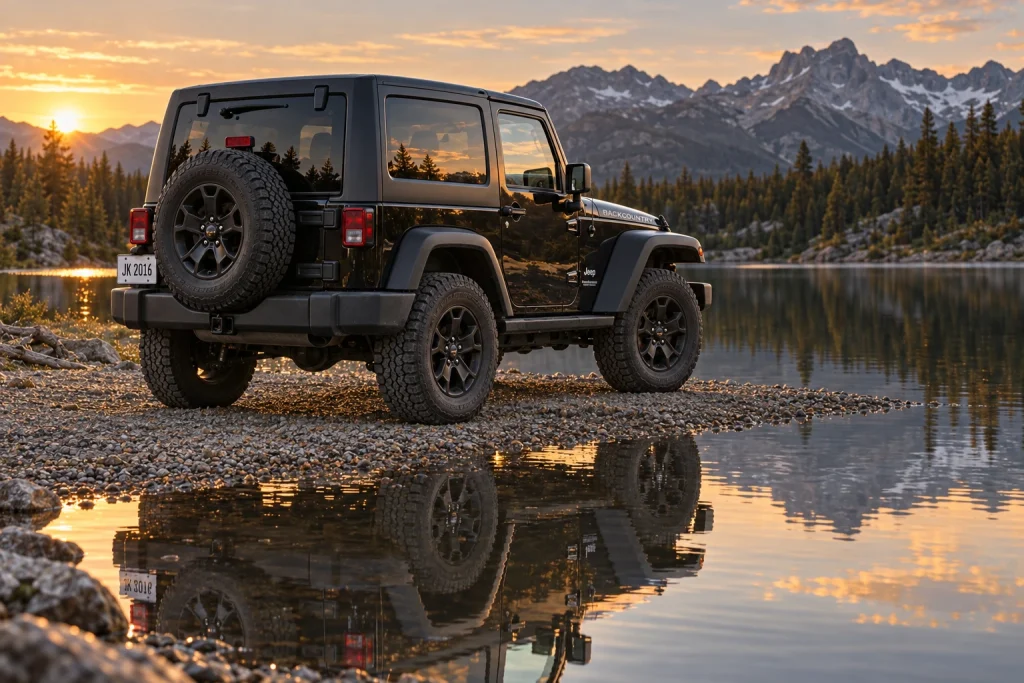
What Size Tires Fit My Jeep Wrangler JK? Upgrading your tires and suspension is usually the first step in any Jeep Wrangler JK build. However, figuring out exactly what fits without causing annoying rubbing issues or requiring fender modifications can be a massive headache. Can you run 33s on a stock JK? What lift kit height is actually required to properly clear 35-inch mud-terrains while flexing on the trail?
Take the guesswork out of your build with our interactive Jeep JK Tire Size & Lift Calculator. Simply select your desired tire size and your suspension setup below. The calculator gives you a planning estimate: roughly what tire diameter your setup can be expected to clear, what backspacing that points toward, and whether fender work is likely to come up. It is a starting point for a build plan, not a fitment check — nothing that runs in a browser can confirm clearance on your actual Jeep.
Backspacing and offset are not interchangeable numbers. JK wheel backspacing versus offset covers how each one changes clearance before you commit to a wheel.
If the suspension is still stock, check the largest tire a stock JK can run before treating diameter alone as proof of fitment.
Once you have an estimate to work from — and have checked it against the actual Jeep — the JK 35-inch tire comparison is where to narrow the actual tire choice.
Use this calculator as a planning tool
A tire-and-lift result is a starting estimate, not a universal fitment guarantee. Tire diameter and width, wheel backspacing, suspension height and condition, steering travel, alignment, vehicle load, body/trim variation and off-road articulation can all change where clearance is needed. Confirm clearance through the full steering and suspension range before purchase or installation.
Start with the actual vehicle configuration, then continue through the JK Tire, Wheel and Gearing Fitment Hub, the Modification Planning Checklist, and the Jeep JK Technical Encyclopedia. For 2018 JK tire/loading and maintenance context, consult the Owner’s Manual and Mopar’s maintenance schedule; use matching documentation for other model years.
Suspension Fitment & Gearing Analysis Engine
Calculates maximum clearable tire diameter, wheel backspacing limits, and target axle gear ratios based on factory powertrain configurations and suspension mechanics.
Required Structural & Mechanical Modifications:
💬 The “Partner Approval” Alibi
—
📄 Generate Your Custom Build Sheet
Copy this summary to share with your mechanic or parts supplier.
Don’t Torque It Blind.
Get the Post-Lift Torque Re-Check Checklist sent to your inbox. It covers the fasteners worth re-checking after your first few hundred miles, with the source and verification status shown for each figure.
We never spam. You’ll receive the PDF immediately.
Jeep Wrangler JK Lift and Tire Integration: Structural Mechanics
Configuring a clean-clearing wheel and tire package on the Jeep Wrangler JK platform requires a balance of vertical lift height, fender clearance, and wheel backspacing. Simply forcing a large tire diameter into the wheel well without correcting suspension geometry leads to systematic component failures and extreme tire rubbing against the frame and sway bar links.
Powertrain Gearing and Powerband Calibration
Tire diameter modifications directly alter the final drive ratio of your vehicle. The 2007-2011 JKs equipped with the 3.8L EGH V6 operate on a higher torque peak, making them exceptionally sensitive to performance degradation when larger tires are installed without immediate differential gear changes. Conversely, the 2012-2018 3.6L Pentastar V6 handles larger loads more efficiently but still requires gear changes to prevent transmission hunting and maintain standard highway cruise RPMs.
- Street/Daily Configurations: Keeping tire sizes between 32″ and 33″ generally preserves stock axle dynamics on 3.6L models, though 3.8L variants with an automatic transmission will feel an immediate loss of overdrive capability.
- Trail & Overlanding Configuration: Transitioning to a 35-inch tire is widely considered the maximum practical capability for a standard daily driver, requiring a minimum of 2.5 inches of suspension lift to maintain acceptable compression travel.
The Critical Role of Wheel Backspacing and Scrub Radius
Factory Jeep Wrangler JK configurations utilize a high positive offset wheel yielding approximately 6.25 inches of backspacing. When mounting a wide tire profile (such as a 12.50-inch or 315mm cross-section), the tire sidewall will make heavy contact with the front factory lower control arms and sway bar links at full steering lock.
Heavy Trail Articulation & Structural Axle Limits
When selecting setups for deep trail articulation and rock crawling, the mechanical limits of the factory axles become a major factor. Mounting a heavy 37-inch or larger tire package on a factory front Dana 30 or Dana 44 housing introduces massive stress to the outer C-sections and axle tubes during hard impacts.
- Axle Reinforcement Mandate: Hard off-road usage with 35″ to 37″ tires requires welding heavy-duty steel C-Gussets to the front axle knuckles to prevent irreversible bending of the factory housing geometry.
- Fender Clearance Options: High-clearance flat fenders allow the use of larger tire profiles under lower lift heights, keeping the vehicle’s center of gravity down and mitigating roll center instability.
The Jeep Wrangler JK “Will It Rub?” Master Fitment Matrix
Use the definitive table below to quickly reference the minimum required suspension lift, optimal wheel backspacing, and trail rubbing risk for the most common Jeep Wrangler JK tire sizes. Note: “Stock Backspacing” refers to the factory 6.25-inch wheel offset.
| Tire Size | Minimum Lift Height | Required Backspacing | Fender Style | Trail Rub Risk (Disconnected) |
|---|---|---|---|---|
| 33″ (285/70R17) | Stock (No Lift) | 4.5″ or 1.5″ Spacers | Stock Flares | Low |
| 35″ (315/70R17) | 2.5″ Lift Kit | 4.5″ or 1.5″ Spacers | Stock Flares | Medium (Needs bump stops) |
| 35″ (315/70R17) | 1.5″ Leveling Kit | 4.5″ or 1.5″ Spacers | Flat Fenders | Low |
| 37″ (37×12.50) | 3.5″ Lift Kit | 4.5″ Maximum | Flat Fenders | Medium (C-Gussets required) |
| 38″ – 40″ | 4.5″+ Long Arm | 3.5″ to 4.0″ | Flat Fenders | High (Requires 1-Ton Axles) |
The Collateral Damage Matrix: What 35s Actually Do to Your JK
Upgrading to a heavier, larger diameter tire increases unsprung weight and rotational mass. This creates a cascading effect of mechanical stress on factory components designed for 32-inch street tires.
Front Axle (Dana 30)
The Risk: Bending the C-knuckles or snapping axle shafts under load.
The Fix: Weld-on C-Gussets are mandatory for 35s if taken off-road. Consider chromoly axle shafts.
Factory Ball Joints
The Risk: The factory nylon-lined ball joints will experience accelerated wear and develop play within 10,000 miles, leading to Death Wobble.
The Fix: Upgrade to Heavy Duty (HD) greasable ball joints (e.g., TeraFlex or Synergy).
Braking System
The Risk: Significantly increased stopping distance due to rotational inertia. Brake fade on long descents.
The Fix: Upgraded brake pads (e.g., Power Stop Z36) minimum. Big Brake Kit (BBK) recommended for 37s.
3.6L Pentastar V6 (2012-2018) Highway Gearing Chart
The chart below indicates engine RPM at 70 MPH with an automatic transmission (W5A580). For the 3.6L engine, the optimal powerband for highway cruising is between 2,500 and 2,800 RPM.
| Tire Size | 3.21 Ratio | 3.73 Ratio | 4.10 Ratio | 4.56 Ratio | 4.88 Ratio | 5.13 Ratio |
|---|---|---|---|---|---|---|
| 32″ (Stock) | 1,850 RPM (Sluggish) | 2,150 RPM (Optimal) | 2,360 RPM | 2,625 RPM | 2,810 RPM | 2,950 RPM |
| 33″ | 1,790 RPM | 2,080 RPM | 2,290 RPM (Optimal) | 2,545 RPM | 2,725 RPM | 2,860 RPM |
| 35″ | 1,690 RPM (Avoid) | 1,960 RPM | 2,160 RPM | 2,400 RPM (Optimal) | 2,570 RPM | 2,700 RPM |
| 37″ | 1,600 RPM (Avoid) | 1,850 RPM | 2,040 RPM | 2,270 RPM | 2,430 RPM (Optimal) | 2,550 RPM (Optimal) |
Tire Width Physics: “Pizza Cutters” vs. “Wide Boys”
When selecting a 33-inch or 35-inch tire, JK owners must decide between a narrow profile (e.g., 255/80R17 or 285/70R17, often called “Pizza Cutters”) and a wide profile (e.g., 12.50 inches wide).
The Case for Narrow Tires (Pizza Cutters)
- Aerodynamics & MPG: Less rolling resistance and frontal surface area yields significantly better fuel economy.
- Winter Performance: Narrow tires cut through deep snow and slush to find the hard pavement beneath, whereas wide tires “float” and hydroplane.
- Clearance: Narrow tires are far less likely to rub the sway bar at full steering lock, often eliminating the need for wheel spacers.
The Case for Wide Tires (12.50+)
- Flotation: In deep mud, soft sand, or marshy terrain, a wide footprint (especially when aired down to 12 PSI) prevents the vehicle from sinking.
- Lateral Stability: A wider track width offsets the increased center of gravity introduced by a suspension lift.
- Aesthetics: Provides the aggressive, traditional off-road stance most builders prefer.
Jeep Wrangler JK Axle Survival & Reinforcement Matrix
Larger, heavier tires increase the loads a front axle housing sees, which is why reinforcement comes up in JK build planning. The table below reflects what JK owners and fabricators commonly report, not manufacturer load ratings, and we have not verified it against Jeep axle specifications. Use it to frame the question, then get the actual axle inspected before committing to a tire size or deciding reinforcement is unnecessary:
| Tire Size | Dana 30 Front Axle (Non-Rubicon) | Dana 44 Front Axle (Rubicon) | C-Gussets Needed? | Truss / Sleeves Needed? |
|---|---|---|---|---|
| 33″ Tires | Commonly run without reinforcement | Commonly run without reinforcement | No (Street & Light Trail) | No Modifications Required |
| 35″ Tires | Marginal (Risk of bent Cs) | Commonly run; monitor ball joints | Highly Recommended | Recommended for hard trail use |
| 37″ Tires | Critical Failure Point | Maximum Limit (Needs upgrades) | Mandatory | Mandatory + Chromoly Axle Shafts |
| 38″ – 40″ Tires | Not Compatible | Immediate Failure Risk | N/A | Full 1-Ton Axle Swap Required (Dana 60) |
The Real-World Jeep JK True Tire Size Database
Do not rely entirely on nominal sidewall designations. The data table below documents the actual measured outer diameter and cross-section width of the most popular off-road tires when mounted under vehicle weight at standard operating pressures (28-32 PSI):
| Tire Model | Stamped Size | Actual Mounted Diameter | True Section Width | Fitment Specification Notes |
|---|---|---|---|---|
| BFGoodrich All-Terrain T/A KO2 | 35×12.50R17 | 33.85″ | 12.10″ | Runs noticeably short. Provides a wider safety margin against fender rubbing under full compression. |
| Nitto Trail Grappler M/T | 35×12.50R17 | 34.84″ | 12.52″ | True to size. Heavy carcass profile requires upgraded ball joints and track bar reinforcement due to high rotational mass. |
| Falken Wildpeak A/T3W / T4A | 315/70R17 | 34.45″ | 12.30″ | Measures closely to specification. Squared shoulder architecture increases likelihood of sway bar rub at full steering lock on stock wheels. |
| Goodyear Wrangler DuraTrac | 315/70R17 | 34.40″ | 12.20″ | Lightweight hybrid tire options. Minimizes unsprung power loss but offers thinner sidewall protection on sharp trail rocks. |
| Toyo Open Country M/T | 37×12.50R17 | 36.85″ | 12.60″ | Extremely heavy tread structure. Immediate axle trussing, heavy-duty inner C-gussets, and chromoly inner shafts required. |
Related JK Technical Guides
Complete your build and troubleshoot geometry issues with our JK diagnostic tools:
- 🔗 Jeep JK Gear Ratio Calculator
Calculate optimal highway RPMs before upgrading to 35″ or 37″ tires. - 🔗 How to Measure True JK Lift Height
Stop guessing your spring sag. Measure true suspension height directly from the axle tubes. - 🔗 The Definitive Death Wobble Diagnosis Protocol
Isolate front-end clunks and track bar failures caused by altered suspension geometry.
Written and maintained by John Dason
Lead Industrial Maintenance Engineer | JK Technical Specialist. John applies clinical diagnostic standards to Wrangler maintenance. Learn more on our Technical Command Hub.